Should you buy a conical or flat burr coffee grinder?
Once you clearly understand how you need to control the amount of “fines” with Bimodal and Unimodal grinders, the next thing to consider is whether we should open our wallet for a grinder using Conical Burrs or Flat Burrs? This is often the most expensive investment in your brewing setup, ranging from a few million to tens of millions of VND. A wrong purchasing decision not only wastes money but also completely ruins expensive Specialty bean batches.
Conical Burrs bring richness
Let us start with the most popular and familiar burr type. Almost 100% of famous hand grinders (such as Timemore, 1Zpresso, Comandante) and classic automatic machines like Niche Zero use conical burrs.
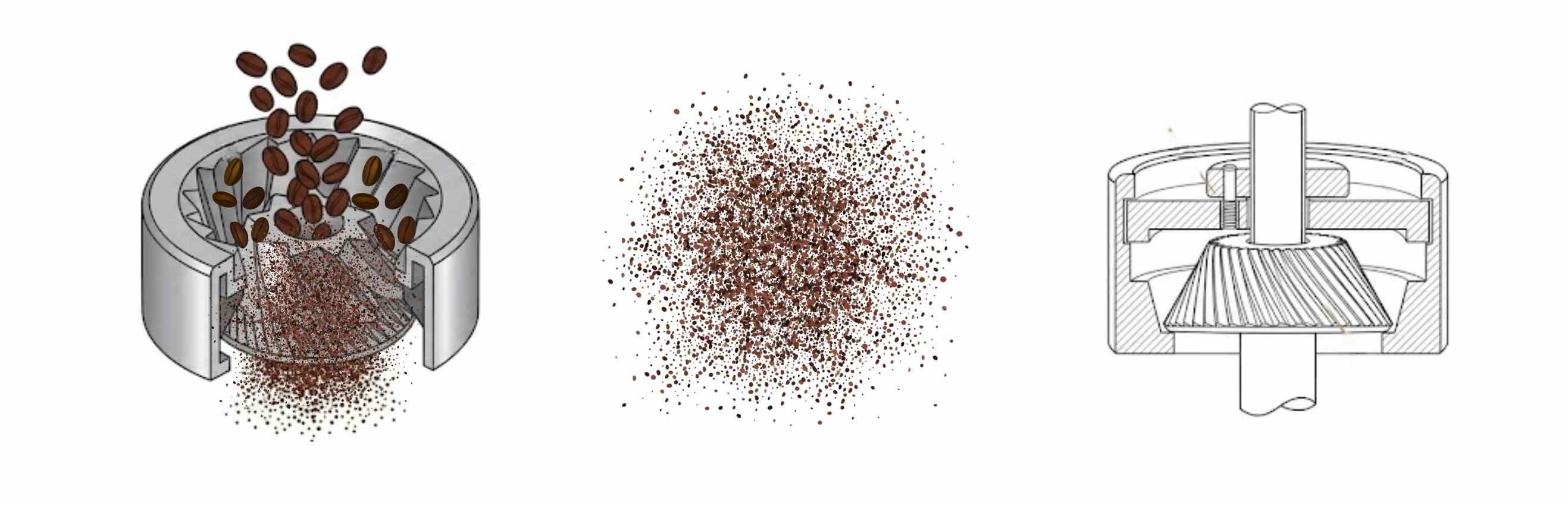
Conical burrs consist of a serrated cone-shaped core rotating inside a fixed steel ring. As coffee beans drop down due to gravity, they get caught between the gap and are gradually ‘crushed’ until they are small enough to pass through below.
(Image generated by AI)
This “crushing” action is identical to when you use a pestle and mortar. It creates a quantity of standard-sized particles, but at the same time also generates a lot of tiny fine particles (Bimodal structure). It is precisely this amount of fines when blending into water that creates a cup of coffee with an extremely thick, smooth, and rich body.
In in-depth review videos (like the Niche Zero vs Lagom P64 comparison article), expert James Hoffmann explained this phenomenon very clearly: Conical burrs tend to blend flavors together into a warm whole. It is the perfect choice to serve as a base for milk-based coffee drinks (Latte, Cappuccino), or to honor medium and dark roast bean batches carrying notes of chocolate, caramel, or roasted nuts.
Flat Burrs create clarity of flavor.
If conical burrs are the traditional mortar and pestle set, then flat burrs are like a super precise slicing machine in modern kitchens.
Because the beans are ejected immediately after being cut, they are not rubbed or crushed repeatedly. The result is that the produced powder has extremely high uniformity (Unimodal) and almost completely eliminates fine dust.

Flat burrs feature two parallel ring-shaped steel discs. As the motor spins at high speed, centrifugal force flings beans from the center to the edge, where sharp slots decisively slice them before immediate ejection from the grinding chamber.
(Image generated by AI)
Expert Lance Hedrick, through a series of blind tasting tests on his YouTube channel (such as the video Flat vs Conical Burrs: What is the Difference?), has proven the power of this design: Flat burrs are born to dissect flavors. Just like you switch from watching an old cathode-ray tube TV to a sharp 4K TV, flat burrs clearly expose each flavor note. If your bean batch carries notes of jasmine, lemon, and black tea, you will taste all three of those things distinctly, without clinging to each other at all, creating an extremely clean drinking sensation (Clean cup).
Who should invest in a flat burr coffee grinder?
Flat Burr grinders are always more expensive than Conical ones because they require an extremely powerful motor to generate centrifugal force, along with mechanical machining accuracy down to the micrometer so that the two grinding discs are absolutely parallel (Alignment). So when is this investment truly worth it?
Let us look at the practical conclusions from tens of thousands of Home-baristas on professional communities like Reddit:
Do not upgrade to Flat Burrs if:
You are a loyal devotee of traditional Espresso, passionate about the rich smoothness of iced milk coffee, or your cabinet is full of dark roast bean batches. Strolling around the r/espresso forum with the classic keyword “DF64 vs Niche Zero“, the community always warns that: If you use a flat burr machine (like the DF64) to extract dark roast beans, your cup of coffee will lose its smoothness, becoming thin, empty, and even harsh. In this case, sticking with a high-end hand grinder or investing in a Niche Zero (Conical) is the most satisfying “End-game” stopping point.

Beans are ground with uniform size, the cup of coffee becomes fine and smooth.
DO upgrade to Flat Burrs if:
You are infatuated with the world of Pour-over (V60, Kalita) and Light Roast Specialty bean batches full of fruity acidity from Africa (Ethiopia, Kenya).
Pay attention to this sign, when you brew Pour-over with a conical grinder, the flow is constantly clogged (Fines Migration), the thick muddy layer at the bottom of the filter makes the cup of coffee turn bitter, and you cannot possibly find the “juicy fruit” flavor as described by the roaster.
At this moment, read the discussion threads on r/pourover (such as the thread “Fellow Ode Gen 2 vs Comandante“). The solution with absolute community consensus is upgrading to new-generation Flat Burr machines like the Fellow Ode Gen 2 (dedicated to Pour-over) or DF64 (multipurpose). With a large 64mm grinding disc size, they eliminate fine dust and completely liberate the flow. Immediately, your V60 cup will brighten up, become crystal clear, and taste exceedingly sweet. That is the exact moment the money you invested yields a 100% return on investment.
In the art of extraction, there is no such concept as “the best grinder in the world”, but only “the grinder most suitable for the coffee beans you are drinking”.
Conical burrs are the embodiment of stability, the warm embrace that brings body and smoothness to traditional cups of coffee. Meanwhile, Flat burrs are a sharp scientific prism, illuminating clarity and dissecting the most delicate flavor notes of the specialty coffee world. Be honest with your palate, choose the right mechanical ‘ideology’, and your home brewing corner will officially reach the End-Game threshold without wasting even a single penny.


-

Ruiru 11 – Kenya’s substantial coffee variety
-
Sustainability in the coffee industry and its manifestations
-
EVERYTHING YOU NEED TO KNOW ABOUT COFFEE FROM SIDAMA, ETHIOPIA
-
Why is Gesha Panama the most expensive coffee in the world?
-
Is ICO’s income benchmarking study for coffee farmers really useful?



SPECIALTY COFFEE