Stirring in V60 – Yes or no?
After using a WDT tool to eliminate channeling in the extreme pressure environment of Espresso, at this point, it is exactly how you pour water and apply physical impact on the coffee bed that will determine the success or failure of the coffee cup. That is when questions about how to handle the V60 arise!
When scrolling through coffee brewing forums and communities, you will easily get confused among countless conflicting pieces of advice: some recommend stirring vigorously with a spoon, some say only to shake the dripper gently, while others absolutely forbid touching the cone. Let’s “demystify” the concepts of flow physics, decode Turbulence, and directly compare the 3 most classic schools of thought, helping you clearly understand the nature instead of mechanically copying recipes.
Turbulence and the “high & dry” defect
Before choosing a technique with the V60, we need to clearly understand the physical tool we are manipulating: Turbulence.
What is Turbulence? This is the force generated by the kinetic energy of the water stream lifting the coffee grounds up, or by active physical actions (such as stirring with a spoon or shaking the dripper). Turbulence helps water blend into the grounds faster, thereby accelerating the rate of flavor extraction.
However, Turbulence is a double-edged sword:
- If the agitation is too strong: The fine particles (fines) in the coffee will be stirred up, then sink straight down and block the capillary pores of the paper filter at the bottom. The dripper gets clogged, and the stagnant water soaking the grounds for too long will produce bitterness and astringency, completely ruining the clarity of the coffee cup.
- The High & Dry defect (If the agitation is too little): When you pour water too gently, the coffee grounds will be pushed upward by the water stream, clinging tightly to the paper filter wall and sitting there bone-dry (the High and dry phenomenon).
When the grounds stick to the dripper wall, water will take a “shortcut,” bypassing right through the empty paper filter (the Bypass phenomenon) instead of passing through the coffee bed. As a result, your coffee cup will be weak and hollow.

The ultimate goal of the art of Pour-over is to create a “just enough” Turbulence: Strong enough to lift all the grounds up to absorb water and clean the dripper wall, but not too violent to avoid causing the fines to sink and block the bottom.
Using V60 with the Excavation technique
This is the action of using a spoon (or a small bamboo paddle) to dig and stir up the coffee bed from the very bottom. This technique was widely popularized by expert James Hoffmann and is applied mainly during the Bloom phase (pre-wetting when pouring the first small amount of water).
Why “excavate”? Freshly roasted coffee beans contain a large amount of CO2 gas. When hot water hits them, CO2 escapes aggressively, pushing the water away and creating “dry grounds pockets” hidden deep under the bottom of the dripper. These dry grounds sections will not be extracted. The action of aggressively digging with a spoon during Bloom ensures that 100% of the coffee grounds absorb water, creating a perfect and uniform launching pad for subsequent pours.
On Reddit’s r/pourover, the community has reached an absolute consensus: You should only excavate the grounds during the Bloom phase. If you use a spoon to stir during subsequent pours (when the water is filling up the dripper), you will accidentally compress the entire layer of fines, causing it to sink straight to the bottom and instantly clog the dripper. do not arbitrarily add new content or omit content.

Excavation is a violent but extremely necessary technique during the pre-wetting phase (Bloom) to eliminate dry grounds pockets. However, it acts as a “poison” causing clogging if you abuse it in the subsequent stages.
(Image generated by AI)
Using V60 with the Rao Spin (swirling) technique
The Rao Spin involves holding the entire V60 dripper and gently swirling it in a circular motion after pouring water. It was pioneered by Scott Rao and Jonathan Gagné (author of the famous coffee physics book).
The circular swirling motion creates centrifugal force. This force generates micro-vortices that sweep away all the coffee grounds clinging to the paper filter wall (the High and dry defect) and wash them back down. At the same time, when the water drains completely, this swirl helps the entire coffee bed lie perfectly flat at the bottom (flat bed), ensuring that the water stream passes through every point with equal pressure.
But if you swirl the dripper too violently or continuously for too many rounds, you accidentally turn the V60 into a miniature centrifuge. The larger coffee particles will be flung to the outer rim, while the entire layer of fines will be sucked into the center and sink straight down into the exit hole. The consequence is a thick layer of mud at the bottom of the dripper, the drawdown time prolonged by a whole minute, and a bitter, astringent cup of coffee.

The Rao Spin is an excellent technique to clean the dripper wall and create a flat bed, but the secret is moderation. You should only swirl 1 to 2 rounds extremely gently. The harder you swirl, the higher the risk of clogging.
(Image generated by AI)
Using V60 with the Center Pour technique
This is the hottest trend right now, initiated by expert Lance Hedrick. The brewer will lower the kettle spout, pouring a very small and smooth stream of water into one exact single point at the center of the dripper (Center Pour), minimizing the use of holding the dripper to swirl or using a spoon to stir.
By pouring the water extremely smoothly, the layer of fines is completely undisturbed. At this point, the coffee bed itself stays still and acts as a “static filter wall.” Water weaves through the coffee bed very quickly and smoothly, pushing clarity to the highest level, helping you clearly taste each distinct floral or fruity note without any bitterness.
However, this low-agitation technique is extremely “picky” when it comes to hardware. It requires you to have a high-end grinder that creates a highly uniform particle size distribution. If your grinder is of poor quality (producing many boulders), the lack of agitation will prevent the water stream from extracting enough soluble compounds from these large particles, rendering the cup of coffee sour and hollow.
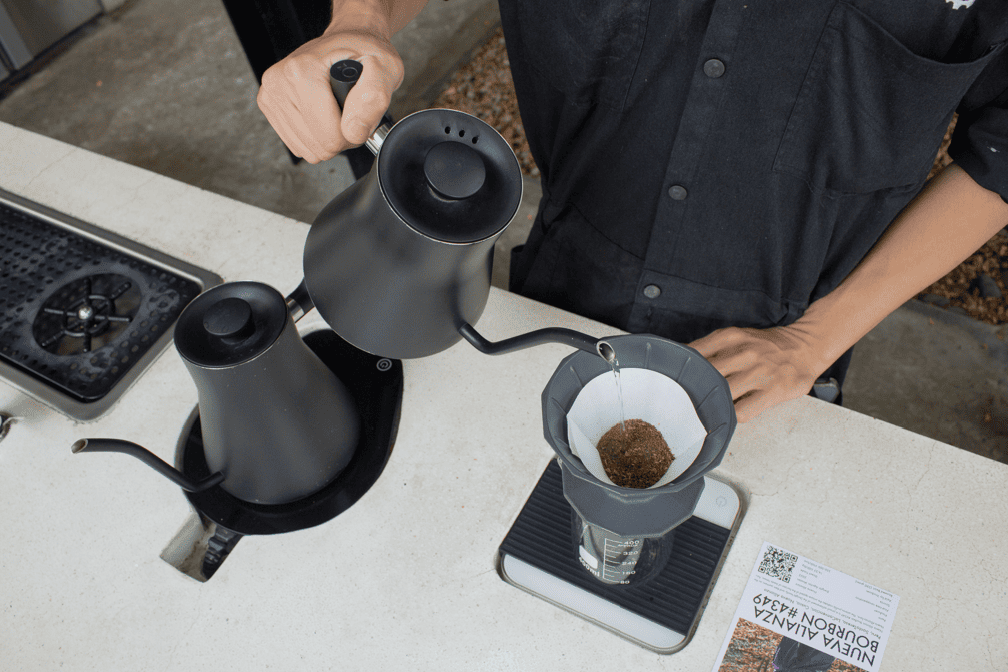
The Center Pour is the highest realm of extraction for light roasts to seek ultimate clarity, but it depends entirely on the quality of the grinder you are using.
Choose your technique based on the “hardware” you currently have…
As you can see, no single technique holds absolute supremacy or is inherently flawed. The choice depends entirely on the “weapons” sitting in your home brewing corner.
If you use a grinder that leans toward crushing and creates a lot of fines (like the Kinu M47), stay far away from violent agitation maneuvers. Using the Center Pour is the best way to keep that layer of fines undisturbed, preventing the dripper from clogging.
If you use a specialized pour-over grinder that cuts coffee into highly uniform particles (like the Comandante C40 or 1Zpresso), you can confidently apply the Excavation technique during the blooming phase, and finish with a gentle Rao Spin to clean the dripper wall, pushing extraction to its maximum without any fear of clogging.
Understanding Turbulence will free you from blindly copying recipes. Mastering the water stream and physical forces is the final puzzle piece for you to freely customize flavors, creating personalized Pour-over cups that bear your own signature.