The secret to “maximizing sweetness” in home brewing
While Barista Hustle’s Flavor Map is designed to adjust variables based on taste, coffee professionals look beyond the palate to truly push brewing boundaries. They utilize specialized equipment like the digital Refractometer to accurately measure Total Dissolved Solids (TDS), calculating the Extraction Yield (EY) through physics formulas. This proves that we can extract sweetness to record-breaking levels without introducing a single trace of bitterness or astringency.
The good news is you don’t need to spend thousands of dollars on a refractometer. We are ‘democratizing’ the scientific findings of top experts into two incredibly budget-friendly mechanical tweaks, allowing you to maximize coffee sweetness right in your home kitchen.
The truth behind the 22% coffee extraction limit
To understand why these new techniques emerged, we need to revisit a classic preconception of the Specialty Coffee Association (SCA).
For decades, textbooks have always taught that: The ideal Extraction Yield (EY) should only fall between 18% and 22%. If you over-push the coffee bed and exceed the 22% mark, the cup of coffee will automatically be labeled as “over-extraction” and will definitely carry the harsh bitterness and astringency of wood fiber.
However, pioneering experts like Scott Rao used data from the VST Refractometer to prove the opposite. Empirical data indicated that dry astringency is absolutely NOT caused by a high EY number, but it is caused by the phenomenon of Channeling. When rushing water punctures a few cracks in the filter basket, it locally over-extracts that exact crack and generates the astringent taste.
In other words, the fault lies in the “unevenness”.
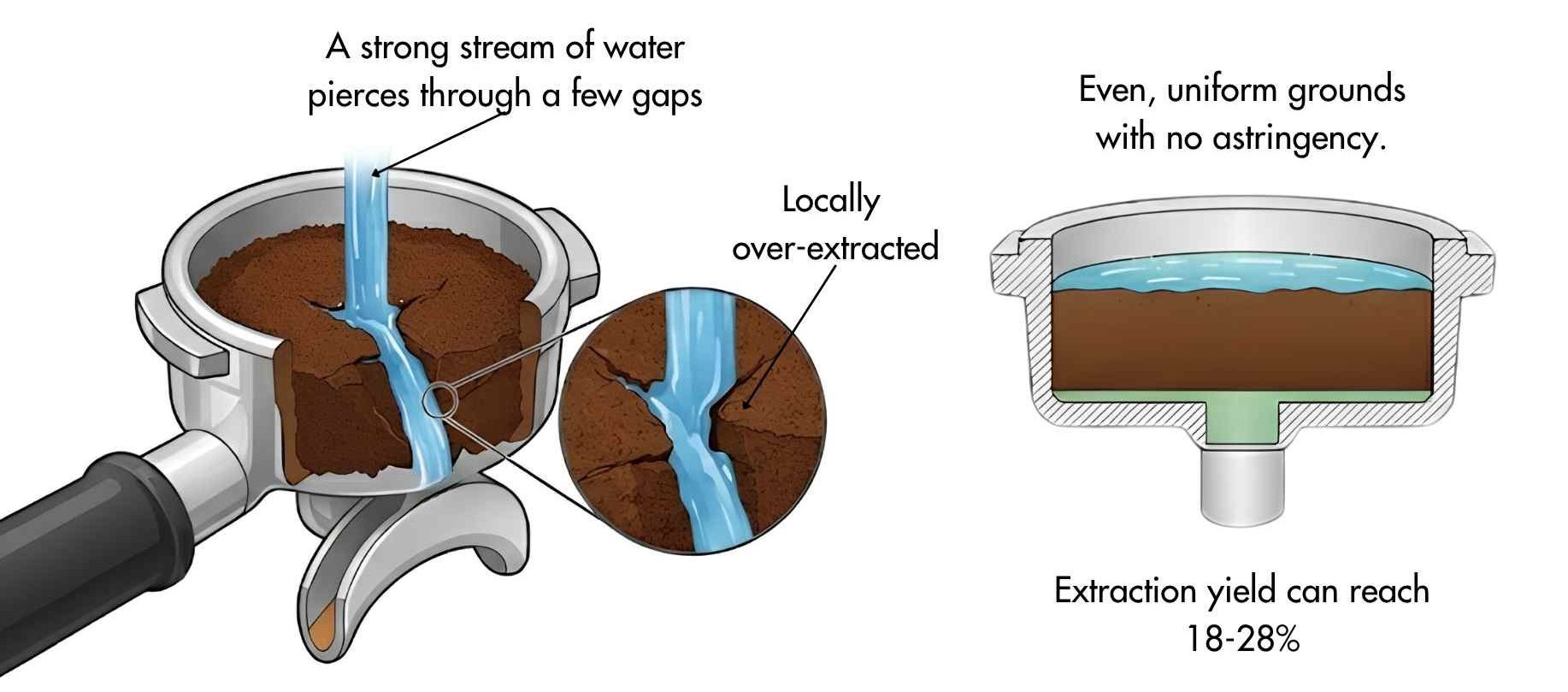
If you distribute the coffee bed perfectly so that water passes through everywhere with equal force, you can completely push the extraction up to the 26% – 28% level while the cup of coffee remains vibrant, sweet like fruit juice, and absolutely free of astringency.
(Image generated by AI)
Method 1: Bottom paper filtration for Espresso
To achieve extreme extraction without channeling, the r/espresso community on Reddit adopted a cheap yet shockingly effective “hack”: placing a paper filter right at the bottom of the espresso metal basket before adding the coffee grounds.
This technique is strongly backed by the research of astrophysicist Jonathan Gagné (author of The Physics of Filter Coffee). By placing the metal filter basket under a microscope, Gagné discovered that the metal holes are inherently uneven in size, causing turbulent hydraulic resistance at the bottom layer.
The thin paper filter completely solves this problem through two mechanisms:
- Pressure distributor: The paper filter acts as a buffer membrane, forcing the high-pressure water flow (9 bar) to spread and pass evenly through every point across the bottom cross-section. This virtually obliterates the risk of channeling at the final exit point.
- Astringency filtration machine: The dry, rough, and tongue-gripping sensation of astringency often comes from lipid molecules (such as cafestol) and the ultra-fine silt that slips through the metal holes. The paper filter traps all of this silt. The result is an espresso with incredible clarity and cleanliness-its fruit flavors separate cleanly like a pour-over, yet it retains the raw intensity of espresso.
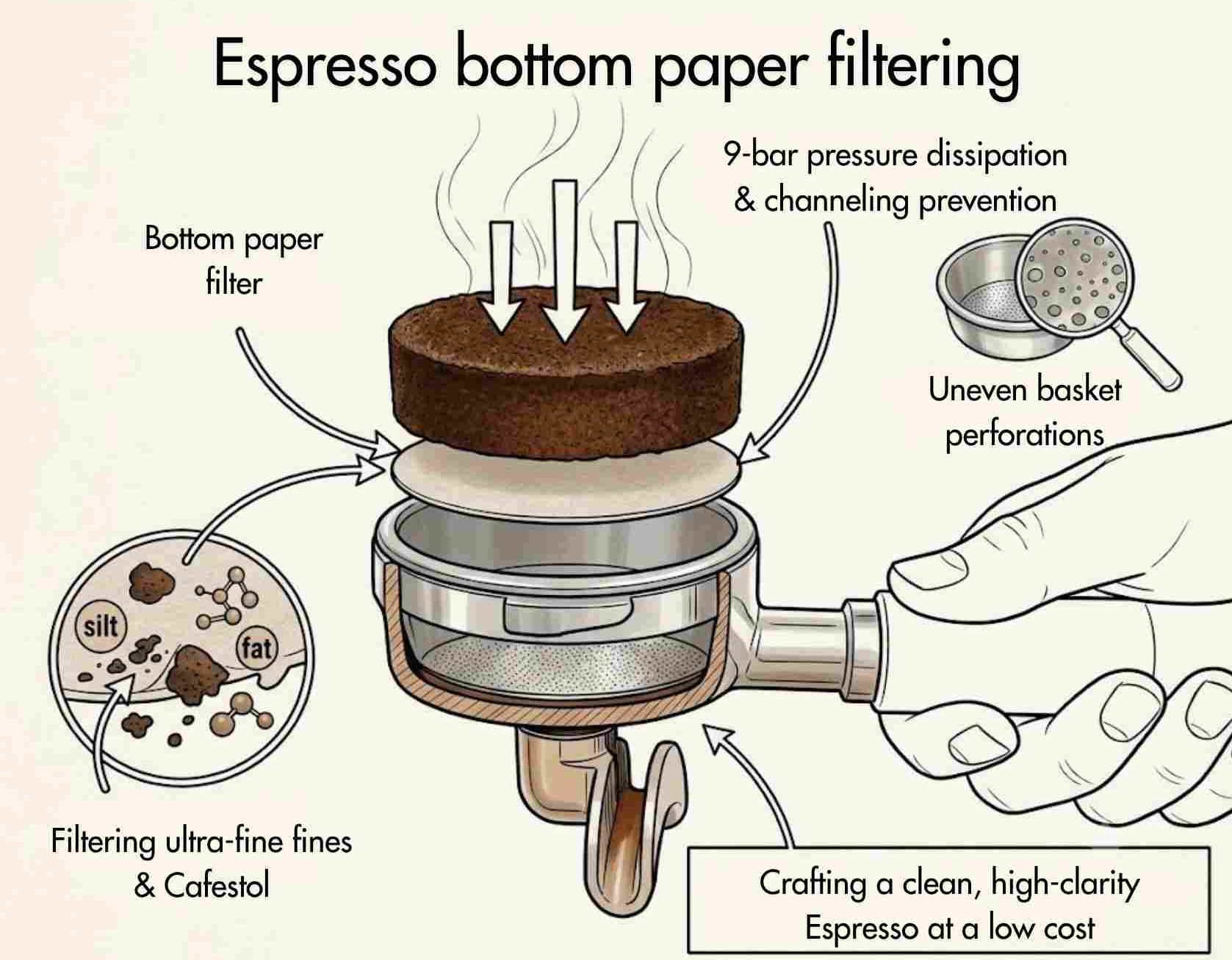
At the cost of just a fraction of a cent per paper filter, you instantly gain an anti-channeling tool that rivals the effectiveness of complex, high-end machinery.
(Image generated by AI)
Method 2: Extending immersion time for Pour-over
While the paper filtration technique is tailormade for espresso, extending the blooming (immersion) time is the absolute key to forcing out the sweetness in paper-filter methods like the V60.
Traditional manuals often advise waiting just 30 seconds during the initial pour, followed by continuous pouring to prevent prolonged steeping and bitter flavors. However, the modern brewing trend – pioneered by coffee expert Lance Hedrick and consistently validated by the r/pourover community through blind tastings – proves the exact opposite.
Why the 30-second rule no longer holds true
Thanks to your application of the frozen bean grinding technique, the coffee beans shatter cleanly and decisively, virtually eliminating the detrimental “ultra-fine dust”. With this fines-induced clogging barrier removed, the risk of over-extraction bitterness from extended steeping completely vanishes.
How to execute:
Dare to change your routine. After your initial pour (combined with the Excavation technique), let the coffee bed rest for 45 seconds to 1 minute or even up to 2 minutes for Extremely light roasts.
Hot water acts as a solvent. By allowing this solvent a period of stillness, it gains the opportunity to seep deep into the core of each coffee cell. The longer the water steeps, the more thoroughly it dissolves complex sugar molecules and fruity aroma esters. Purposefully extending this contact time is the key to “squeezing out” the bean’s natural sweetness without resorting to brutal force.

The journey of quantitative measurement and scientific research ultimately serves to confirm one thing: bitterness and astringency always have specific physical causes, and we can completely resolve them through mechanical techniques.
The meticulous process of formulating DIY mineral water, portioning beans into centrifuge tubes for freezing, applying an RDT mist, carefully utilizing a WDT tool, and adding a bottom paper filter for a Filter Sandwich… these are all tightly interconnected links. Together, they eliminate every physical barrier, paving the way for you to unlock the most exquisite flavor notes that the roaster embedded within each bean. Once your technical foundation is rock-solid, your own palate becomes the ultimate refractometer.


-

COFFEE INDUSTRY IN A FLAT WORLD MODEL: OPPORTUNITIES AND CHALLENGES
-
Coffee Maker Price Breakdown and Analysis
-
How to improve access to finance for small-scale coffee farmers?
-
Comparing coffee growing regions: Global influences on flavor
-
Everything about Laurina coffee – Origin, characteristics, flavor




SPECIALTY COFFEE