Stop Refusing to Use Refractometers
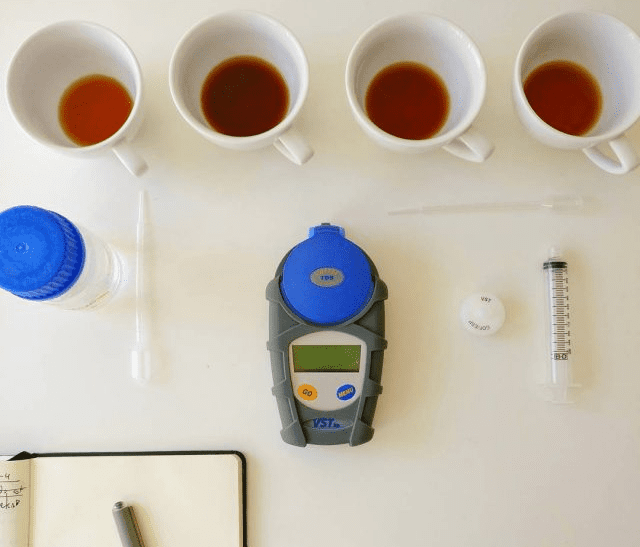
Every cup of coffee is the result of a series of subtle variables: water temperature, pressure, ground weight, and the solubility of compounds. Baristas rely not only on feel but also on precise tools to ensure consistent extraction. A refractometer is one of the most important tools for monitoring extraction ratio and TDS (Total Dissolved Solids ) , but many people are still skeptical about its use.
Extraction Ratio Is Not Always the Decisive Indicator
“Higher extraction ratios don’t necessarily mean better. I’ve made a lot of great espressos, but with low extraction ratios.” This quote reflects an important truth: high and low extraction coffees are not opposites. High extraction ratios and TDS (Total Dissolved Solids) are not the end goal, but rather a manifestation of good coffee.
The key to improving product quality lies in the uniformity of the extraction process . When all variables are controlled at rest – the same weight of ground coffee, the same weight of extract, the same extraction time – the extraction ratio will be optimal. Our goal is not to create the highest extraction ratio, but the most uniform extraction possible. The result is of course a higher TDS, but it is not the number that matters, it is the coffee experience.
“The goal of specialty coffee is not to produce a high TDS coffee, but to create a great coffee for the customer.” In the pursuit of uniformity, TDS is just a proxy for extraction ratio – it’s essentially the same story.
Three Tips From a Professional Barista
Baristas often emphasize that consistent extraction is the key to flavor. The more consistent the extraction, the more balanced and flavorful the coffee. However, high extraction does not necessarily mean better coffee if the extraction is uneven. In fact, a good cup of coffee is the result of a balance between technique and a deep understanding of the coffee bean, not just the numbers on the meter.
The Truth About “Number Tracking”
Many people think that it is “embarrassing” for a Barista to keep track of numbers. But that is a misconception. Measurement helps to increase consistency and control over the process, just like an accountant keeps track of costs or an engineer checks product quality. When Baristas compete in international competitions like the WBC (World Barista Championship) in Bogota, many competitors use scales to measure their espresso shots. This is not a lack of creativity, but a way to ensure standards and consistency in the brewing process.

Would you want coffee farmers to ignore moisture meters and rely on subjective feelings? Of course not. Statistics and data not only help stabilize the production process but also ensure the final quality for customers.
Refractometer and Blade – The Golden Combination
We don’t use a refractometer to decide what coffee to serve to our customers, but it is a quantitative tool to monitor and understand the product. A refractometer can’t tell us if a cup of coffee is good, but it can help us detect subtle differences in extraction that can lead to improvements.

Meanwhile, the Barista’s tongue is a qualitative tool, capable of distinguishing thousands of flavor nuances. However, the tongue also has its limits when the body is not healthy, affecting the perception. Therefore, using only one of the two tools – the refractometer or the tongue – can lead to errors. The combination of the refractometer and sensory experience creates an accurate assessment of coffee quality.
Benefits of Using Refractometer
At roasters and roasters like Sensory Lab, the use of refractometers has saved a lot of money while improving roasting consistency, solubility, and consistency. As a result, the coffee produced is more delicious and more consistent. Refractometers help monitor variables, compare TDS, and improve quality, but still require the Barista’s sensory evaluation.
After reading all this, do you still feel resistant to using a refractor or are you starting to get excited about this extremely important aid?
(*) Image source collected